
Latest
Courts

Federal Jury Convicts Huawei and Three Subsidiaries of Iran Sanctions Violations, Bank Fraud, and Trade Secret Theft

Following a three-month trial in Brooklyn federal court, a jury convicted Huawei Technologies Co., Ltd. and three subsidiaries of Iran sanctions violations, bank and wire fraud, money laundering conspiracy, and trade secret theft.

Read the story
Courts · Read the story
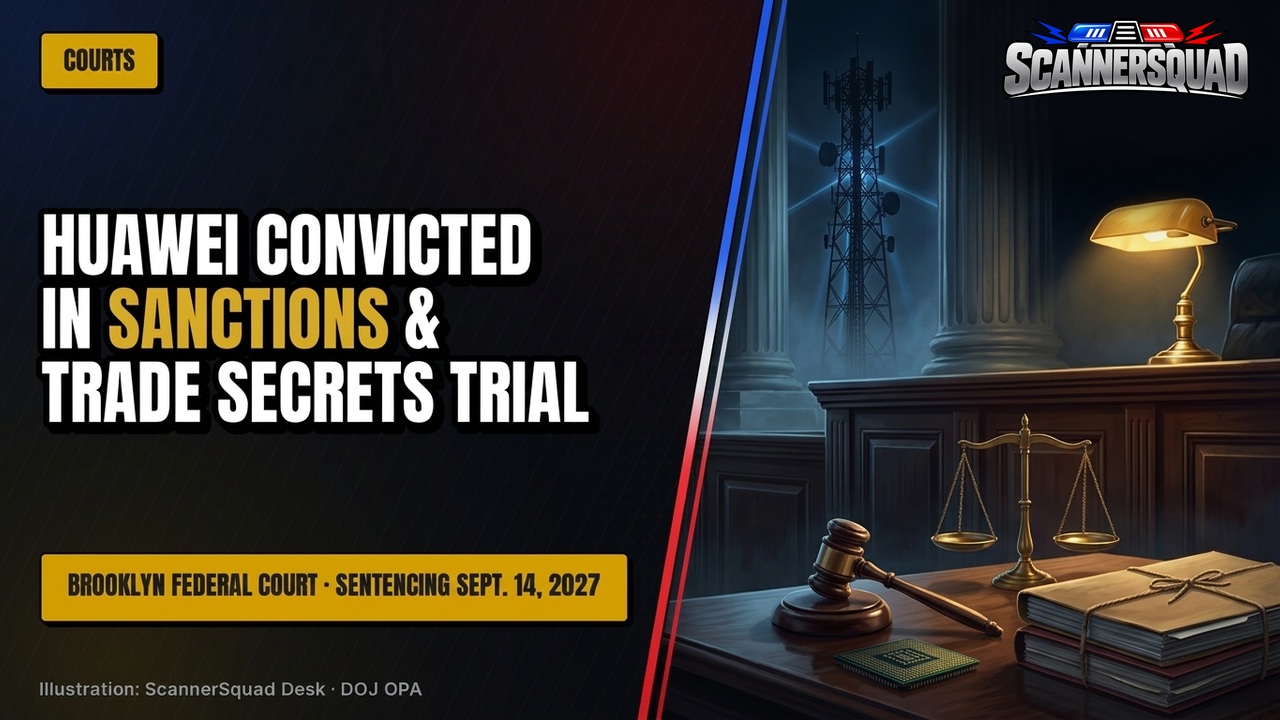
Night-black ScannerSquad Courts thumbnail with gold sticker bars reading Huawei Convicted in Sanctions & Trade Secrets Trial, Brooklyn Federal Court · Sentencing Sept. 14, 2027, divided by a 10-degree blue-white-red light-bar slash from a moody federal courtroom bench and evidence table with a brass banker lamp, gavel, scales of justice, twine-bound dossiers, a microchip, and a telecom tower behind misty columns.
Illustration: ScannerSquad Desk · DOJ OPA
Share this story
4 EntitiesHuawei & 3 Subsidiaries Convicted
3 MonthsFederal Jury Trial in Brooklyn, N.Y.
Sept. 14, 2027Sentencing Scheduled in EDNY

Brooklyn, N.Y. — Following a three-month federal trial, a jury in the Eastern District of New York convicted Chinese telecommunications giant Huawei Technologies Co., Ltd. and three of its subsidiaries on charges spanning Iran sanctions violations, bank and wire fraud, money laundering conspiracy, and theft of U.S. trade secrets, the U.S. Department of Justice announced Tuesday.

Alongside parent company Huawei, jurors found Chinese subsidiary Huawei Device Co. Ltd. and U.S. subsidiaries Futurewei Technologies Inc. and Huawei Device USA Inc. guilty of conspiracy to steal trade secrets, conspiracy to commit wire and bank fraud, substantive wire and bank fraud, conspiracy to defraud the United States, conspiracy to violate and substantive violations of the International Emergency Economic Powers Act (IEEPA), and money laundering conspiracy.

Iran Operations Through Skycom and Bank Deception

Prosecutors proved at trial that Huawei and its affiliates supplied turnkey internet-backbone and mobile-network services to the Iranian government and assisted the regime and Iranian intelligence component Zaeim in monitoring and censoring internet users, including providing surveillance cameras used to track protests, according to the Justice Department.

Operating in Iran under the name “Skycom,” Huawei falsely told global financial institutions, journalists, and U.S. authorities that Skycom was an independent business partner rather than a wholly owned subsidiary and claimed it had restricted its Iran business in 2011. Those false assurances allowed Huawei to secure billions of dollars and access to U.S.-dollar clearing services while evading American sanctions.

Trade Secret Thefts Across Five U.S. Tech Firms

Trial evidence detailed a multi-company campaign to misappropriate proprietary source code, hardware designs, and testing technology from American competitors and partners:

  • T-Mobile (“Tappy” Robot): After signing a non-disclosure agreement (NDA) with T-Mobile, Huawei employees photographed and transmitted technical details of T-Mobile’s touchscreen-testing robot back to China, and one employee carried a stolen robot component out of T-Mobile’s controlled laboratory in a backpack.
  • Cisco Systems: Huawei engineers copied proprietary Cisco router source code—described as Cisco’s “crown jewel”—leaving internal code comments that disguised Cisco’s name spelled backwards as “ocsic.”
  • Fujitsu: A Huawei employee caught photographing proprietary Fujitsu equipment wore a badge falsely identifying himself as working for “Weihua.”
  • CNEX & Quintel: Prosecutors showed Huawei used an undisclosed university researcher to obtain direct access to CNEX hardware and filed a patent application incorporating Quintel antenna technology obtained under an NDA, attaching a confidential Quintel slide.

“For over two decades, Huawei built its global empire on a foundation of fraud, theft, and deception,” Criminal Division Assistant Attorney General Tysen A. Duva said in a statement. U.S. Attorney Joseph Nocella Jr. called the verdict “a step towards accountability” for decades of sanctions evasion and industrial theft.

Penalties and Sept. 14, 2027 Sentencing

When sentenced, Huawei and the three convicted subsidiaries face criminal fines, asset forfeiture, and restitution to be determined by a federal district judge under the U.S. Sentencing Guidelines and statutory factors. Sentencing is scheduled for Sept. 14, 2027, following the FBI New York Field Office investigation.

Sources & Reporting Credits

Reporting verified via the U.S. Department of Justice Office of Public Affairs.

Thumbnail and hero: Illustration: ScannerSquad Desk · DOJ OPA.